Sunday, June 27, 2010

CRASH HELMETS & INCLUSIVITY

So our sanctuary is undergoing 6 weeks of renovations - and I could only laugh out loud when I noticed all the warning signs posted at the entryways: "Danger: Hard Hat Area." Naturally I thought of Annie Dillard's often-quoted thought from Teaching a Stone to Talk: "I do not find Christians, outside of the catacombs, to be sufficiently sensible of conditions. Does anyone have any idea what sort of power we so blithely invoke? Or, as I suspect, does no one believe a word of it? The churches are children playing with their chemistry sets, mixing up a batch of TNT to kill a Sunday morning. It is madness to wear ladies' velvet hats to church; we should all be wearing crash helmets. Ushers should issue life preservers... and lash us to our pews. For the sleeping god may wake someday and take offense..."

We had to bring in scaffolding, circular saws, and scarily heavy . equipment to render our beautiful sanctuary risky. "Oh, it's dangerous now? How long before it's safe to go back in?" I noticed the subheading on the Danger: Hard Hat Area sign - which adds Authorized Personnel Only. "Who shall ascend the hill of the Lord?" Psalm 24 inquires - and the reply, if authoritative for us today, would keep us all out permanently: "He who has clean hands and a pure heart."

And yet, at our denominational annual conference, we had a motion tabled - one about inclusivity. Nobody wants to talk about it: we are weary of the debate on how much inclusiveness is too much. Bizarre to me: it is precisely the necessity of clean hands and a pure heart that requires us to be utterly and uncompromisingly inclusive. Mine aren't clean or pure, and neither are yours - or anybody else's. Inside the building, the chemicals that catalyze the explosion are grace and mercy, which you never find outside a Church. So we realize what God requires, we realize we've whiffed embarrassingly - and that is precisely why we enter, trembling, hoping for mercy, needing nothing less than a transformative explosion of unseen power.

How inclusive then should we be? My small wisdom is this: if any one of us isn't welcome in Church, ever, for any reason, then none of us is ever welcome. God may wake up one day and be grossly offended we ever thought otherwise; God has already noticed, and is grieved - and wishes to strip the place, and us, down to the foundations and start over with us. Danger: Hard Hat Area.


Saturday, June 19, 2010

ORDINATIONS AND LEADERSHIP
This is my year for out of the ordinary ordinations. I flew to Haiti to preach at the ordination of a young man in the community where our Church has a school, granary, and clinic. I think I actually ordained him (with no ecclesiastical authority whatsoever…): after intense questioning in Creole, to which the candidate responded “oui” to every hard question, I was asked to lay my hand on his head and pray. I said “I’m not a bishop,” but in this out of the way place it turned out I was probably the closest thing.

I flew to Liberia to preach at their conference’s ordination service. Ninety ordinands, and a higher number of degrees on the thermometer: immense zeal and a palpable humility on every face, and I felt a bit ashamed of the rock star status they seemed to afford me, whose annual salary may well exceed that of the entire bunch of 90.

I flew to Urbana, Illinois, to a Wesleyan district service where my colleague Kevin Wright was being ordained – and a couple of days later, I looked on my own denomination’s lining up of dozens at a time.

Surely I have some wise reflections from these diverse experiences, but I do not. I am simply in awe of the brute fact that one after another, in this milieu of cynicism and anti-institutional bias, people still put on heavy robes in the heat and line up to get hands laid on them. Each one of these people, in a moment of profound faith or quirky delusion, said Yes to what they thought was a call from God. Not one of them sized up the market, assessed their test results, and thought This is a clever way to prosper in today’s world. To inexplicable impulses skeptics would ridicule, they responded, underwent education and interrogation, and then got sent to places not as famous as Timbuktu to struggle, to try to pray and teach, to lay hands on the sick who quite often die despite the prayers, to people who yawn, who can be petty, who believe fitfully if at all – and then you get old and die doing this?

I am also struck of how little consonance there is between what I have witnessed and the kinds of things we talk about on when we think of the clergy profession nowadays - clergy "leadership" that is. Leadership is a thriving cottage industry, and I’m constantly invited to something or another where we can be sharper, smoother, more successful, to grow the Church, to glisten with administrative acumen, to raise endowments and corral postmodern people into church buildings equipped with snazzy technology.

But this kind of leadership mentality runs on a very different track from the real ecclesiastical processes, and the way people actually answer that mystical call within. When I said Yes, I will give pastoring a try, no one had spoken to me about Good to Great, and I would have laughed if someone had. I was swept up in a frenzy of faith, and wanted nothing more than to go be with some hurting people and pray for them, and to have the privilege of standing up and talking about amazing things I’d read in the Bible. At ordination, none – none! – of the questions are about leadership, or entrepeneurship, or visionary strategies.

I do not yet know what this dissonance means. I do recall an evaluation session of my congregation’s personnel committee. They were weighing my work, and that of my fellow clergy on staff. Rising to what they felt the denominational forms demanded of them, they were laboring over the “needs improvement in…” box; and it is never hard for laity to hatch such a list. In the thick of that endeavor, one woman felt a bit ruffled by this, and objected; in trying to affirm me and my colleagues, she said “Look, these people could have done most anything else for a living, and had an easier life, and made more money. Ministry, to me, looks really hard. I think we should simply consider the fact that God called them, and they said Yes, and we should thank them for doing so, and for being here with us.”

Now, that is no substitute for the real, necessary work of evaluation and professional improvement. But in Haiti, and Liberia, and Urbana, and Lake Junaluska, I watched people of all shapes, sizes, ages, backgrounds, walk slowly forward, kneel, have hands laid on their heads, and rise with smiles, or tears, with family beaming in curious pride, trudging away into the most uncertain future imagineable. Do they know the craft of leadership? Will they master Heifetz or Crouch or Maxwell or Peterson or the bloggers at faithandleadership.com and become wizards of ministry? I find myself uninterested in the answer to that question. I’m in some awe. A bunch of people whose faces I saw, and on whose heads I laid my feeble hands, had said “Oui” to whatever questions were asked of them – by the Church, but more importantly by God. I think all that is left to me is to thank them, or to thank God.

Sunday, May 30, 2010

PREPARING TO SPEAK OF BEAUTY AND GOD

I've been preparing for a talk I’m giving on Monday, June 7, 7pm (to be repeated Wednesday, June 9, 11am) called Talking with God Using Beauty, our Brains, and the Bible. We will look at how Darwin, Monet, Mozart, Michelangelo, Einstein, Charlie Brown, Chopin, and Jewel help us to know God. It’s “multimedia,” meaning I’ve got power point images, and there will also be live music.

For a long time I’ve been reflecting on how we connect with God, and I mean beyond the usual suspects (like the Bible, praying, and worship). What about using our brains (and I don’t mean getting into the old reason vs. faith argument, but simply what we know, or what really smart people know…)? and what about beauty? I’ve written a book on preaching that will come out in a few months called The Beauty of the Word – and it seems to me that we do not think enough about beauty.

Is human achievement, and especially human creativity a gift of God’s Spirit? and if so how does that play out? and how do we wriggle our minds around the wonders of science, art, architecture and music and thereby grow closer to God? What is beauty, anyhow? Why is it so different from cute, sexy, handsome, pretty or "hot"? Rilke said "Beauty is the beginning of terror"... and there is something deep, profound, risky, life-giving about beauty.

If God is Beauty, if Psalm 27 says “One thing I will seek, to behold the beauty of the Lord,” and if even cynics about religion, Bible, prayer and God are moved by beauty, then beauty might be our hope, the only future to faith. What we have in Christianity truly is beautiful, and perhaps we can trust that? instead of striving so hard to be “relevant,” or to prop up traditional norms like the authority of Scripture or the grandeur of our institutions?

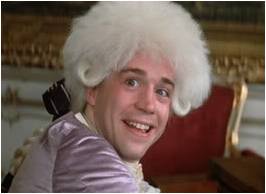
What strikes me as I prepare is recalling how awed I have been throughout my life by the things brilliant people who don’t believe in God have helped me understand about God! Darwin gets trashed by Christians, but his life work opened up new vistas, and far deeper explorations of God’s good creation; or I think about Michelangelo, who thought an artist needed to be holy – and yet Caravaggio, not noted for a squeaky clean character, kept up with Michelangelo. I think about the Peter Shaffer play (and the movie) Amadeus, where Salieri is incensed over the way Mozart seems to overhear the very voice of God, and Salieri is comparatively tone-deaf (despite his avowals of holiness). Can God co-opt people who aren’t believers, who aren’t interested in God at all, and use their genius to inspire and impress the rest of us?

How does God feel about music and art that are not “sacred”? Does God really prefer religious music? or religious books? I think of Karl Barth’s quip: what do the angels sing when they come before God’s throne to praise him? Bach, of course. But what do the angels sing when they are off by themselves? Mozart. Does God dig “secular” novels and movies? Might some of the religious pablum be dull even to God? Chopin doesn’t cheer my soul; instead he breaks my heart – but the sorrow his music taps helps me toward God.

These and other questions will occupy me this week in preparation, and on Monday (and Thursday) when I actually present. Let me know any thoughts or questions you might have…

Wednesday, May 26, 2010

heavens and honey - thoughts on Psalm 19

C.S. Lewis called Psalm 19 “the greatest poem in the Psalter and one of the greatest lyrics in the world.” At first blush, it looks like two Psalms jammed together, one extolling the wonders of creation, the other a surprisingly cheerful view of the Law. But the two are one, God’s wise plan in making the world and us in it, and God’s will, God’s holy requirements that are wired into the very marrow of all God has made.

Musicians have risen to the words of Psalm 19, most famously in Haydn’s The Heavens are Telling. Others may fall silent or be too busy to sing hymns or to utter thanks and praise to God, but the world around us is never mute. Even scientists who don’t believe in God put the marvelous grandeur of God on display: when Charles Darwin reported what he saw on his voyage on The Beagle (cuttlefish, musical frogs, waterhogs, jaguar, flying spider, tortoises, ostriches), he was unwittingly chronicling God’s glory. Clouds, stars, badgers and barnacles together form a wordless, eloquent trumpeting of all that burst from the mind of God.

In ancient times, the sun was thought to be a deity: Shamash, the Mesopotamian sun-god, Aten, the Egyptian divinity… but the massive fireball of the sun is a small toy, a delicate instrument in the true God’s powerful hand. From that holy hand we receive God’s laws – etched into the fabric of creation, handed to Moses on Mt. Sinai, proclaimed by the prophets, taught by Jesus, penned by Paul, explicated by the Church. God has a will, a way, rules and guidelines – and it is fascinating to hear how this Psalmist literally adored and treasured God’s laws. In a crescendo of praise for the law, the Psalmist trembles, perhaps holding a scroll, and moves from “it’s perfect,” to “this gives me wisdom and salvation,” then on to “rejoicing, joy, a sense of being clean” – and then with poetic boldness, the Psalmist employs sensual images: “the law is more precious than gold, sweeter than honey.” Honey has an alluring taste, and savory consistency in the mouth, and it is through the mouth that the Law was read, recited, and obeyed.

The goal in adhering to the Law, the rich benefit of living in sync with what God has revealed, is to please God – and what could be a higher objective? “Let the words of my mouth, and the thoughts of my heart, be pleasing to You, O Lord” (verse 14). In an earlier email series I explored this idea that our talk (or our not talking!) matters to God – as do our thoughts! Of course they do, since God made our mouths, and our brains, and the sun, moon, rabbits and snails, and the commandments and teachings of the Bible. How can we live one more minute without knowing them? And letting them become our agenda for the day?

Here is the entire 19th Psalm, for you to read, ponder, and even pray:

Psalm 19
[1] The heavens are telling the glory of God;
and the firmament proclaims his handiwork.
[2] Day to day pours forth speech,
and night to night declares knowledge.
[3] There is no speech, nor are there words;
their voice is not heard;
[4] yet their voice goes out through all the earth,
and their words to the end of the world.
In them he has set a tent for the sun,
[5] which comes forth like a bridegroom leaving his chamber,
and like a strong man runs its course with joy.
[6] Its rising is from the end of the heavens,
and its circuit to the end of them;
and there is nothing hid from its heat.
[7] The law of the LORD is perfect,
reviving the soul;
the testimony of the LORD is sure,
making wise the simple;
[8] the precepts of the LORD are right,
rejoicing the heart;
the commandment of the LORD is pure,
enlightening the eyes;
[9] the fear of the LORD is clean,
enduring for ever;
the ordinances of the LORD are true,
and righteous altogether.
[10] More to be desired are they than gold,
even much fine gold;
sweeter also than honey
and drippings of the honeycomb.
[11] Moreover by them is thy servant warned;
in keeping them there is great reward.
[12] But who can discern his errors?
Clear thou me from hidden faults.
[13] Keep back thy servant also from presumptuous sins;
let them not have dominion over me!
Then I shall be blameless,
and innocent of great transgression.
[14] Let the words of my mouth and the meditation of my heart
be acceptable in thy sight,
O LORD, my rock and my redeemer.

The complete ePsalms series is archived on our web site.