

Wednesday, March 22, 2017
Worshipful is out now!

Tuesday, March 21, 2017
St. Francis Pilgrimage: October 8-18, 2017

Come with me and walk in the footsteps of
St. Francis of Assisi! One of the great
loves of my life is St. Francis – and the places he graced. October is a beautiful time to be in Italy –
and to ponder together the significance of this greatest of saints. I have been obsessed with St. Francis, and have written on his impact on my life, and the lives of others in Conversations with St. Francis.

We fly direct, Charlotte to Rome, where we’ll
stay at the Cicerone Hotel, in
a great location. We will see San Francesco
in Ripa, which houses the stone cell where Francis slept when he visited Rome,
which has recently been restored - and is stunning.
We’ll visit the great medieval Lateran church where he spoke with Pope
Innocent. We will have a special entry
to the Vatican, the Sistine Chapel, and St. Peter’s – which is especially
moving now, with Pope Francis, who deliberately took St. Francis’s name in
imitation of his life. Some other
fascinating places in Rome I’ll show you are the Catacombs, where early
Christians huddled to worship, and some terrific restaurants and Roman era
sites.

Then we will drive to Greccio, where
Francis created the world’s first ever manger scene. The fabulous view over the Rieti valley is
unforgettable, as is the monastery’s collection of manger scenes from all over
the world.

Then we arrive in beautiful Assisi, where
we’ll stay right in the center of town in the Hotel De Priori – an unbeatable
location. In Assisi, we will see where
Francis was born, San Damiano where he heard God’s call, Santa Chiara which
houses the cross the spoke to him (and the incorruptible remains of his friend
St. Clare), San Rufino where he preached and was baptized, the basilica where
he is buried (and which enjoys Giotto’s fresoes depicting his life), Santa
Maria degli Angeli, the small church he rebuilt with his own hands that became
the focal point of the growth of the Franciscan movement, and more.

Then we will sadly exit Assisi and head
into Tuscany to visit Cortona and Arezzo, marvelous Franciscan sites, before an
afternoon worship service at La Verna, where Francis prayed and then received
the holy stigmata. Then to Florence –
where we will stay at the Hotel Mediterraneo, visit the Duomo, the Baptistery,
and more.
Finally, after leaving Florence, we’ll
stop in Ravenna to see the most amazing fourth century mosaics, some of the
most stunning early Christian art, and stay at Padua, the home of Francis’s
great friend, St. Anthony. Finally we
will stop in Venice and return home to Charlotte.
Trust me: this is the trip of a
lifetime! Come with us. The cost is just $3750 per person, which is
surprisingly affordable for this kind of trip.
Includes airfare, accommodations, ground transportation, entry fees, and some but not all meals. $300 when you register; the rest later. Deadline = July 15, but we might fill up sooner. You can inquire without paying... Email me if you’re interested.


Monday, March 20, 2017
Her Utmost - For Decades, & even Facing Dementia

Who reads the same book, cover to cover, at least a page every day, over and over for more than sixty years? - and the Bible doesn't count. My mother-in-law, Jean Stevens Stockton. Early on, when Lisa and I were dating and then engaged, I noticed something remarkable I've observed ever since for over thirty years: whenever I get up from sleep when staying with them, I wander into the front room - of several houses now - and find Jean sitting in a chair with her feet up on an ottoman, not for comfort, but to provide a human desk, across which would be splayed an open Bible, various notes on pieces of paper, and that book, My Utmost for His Highest, by Oswald Chambers. Every day for thirty plus years. And I've only witnessed less than half of her life with My Utmost.
Naturally, I’ve been impressed, and
moved by this immense devotion to God, this singular commitment to learn and
grow into the things of God. But I never
asked many questions, not wanting to pry into what obviously was deeply
personal, private devotion –
 until a day in February when the Wall Street Journal featured a book review that caught my eye. Macy Halford, My Utmost: A Devotional Memoir, a book about the book her grandmother had given to her and what it had meant in her life.


I
thought, I know that book – sort of. I’d
never read it myself. You would think
that I, as a clergyperson, would be a voracious consumer of devotional
books. But they generally strike me as
too thin, too trivial, and I just get bored.
The Halford review piqued my interest
though. I knew it had become almost a
sacred object in our family – and that Jean had decided she would, on her
death, bequeath it to my daughter, her granddaughter Sarah, who had always
shown outsized interest in it. I put
Halford’s book about her grandmother’s gift in my Amazon shopping cart,
thinking it might be a quirky gift to my daughter when her birthday rolled
around.
Then, that Sunday, before church, I was
thumbing through the New York Times
Review of Books – and there
it was again: Macy Halford, My Utmost. I’m not big on “signs.” But I did revisit my Amazon cart and actually
ordered her book. And while I was signed
in, I had them ship a copy of the book, Chambers’s book.

They showed up together in a package. I started Halford that evening, and Chambers
the next morning – February 22.
Chambers’s topic? “Spiritual
tenacity,” something I’ve dreamed of but have never possessed. Thinking of Jean’s multi-decade discipline, I
read that day’s very first sentence, which I knew she had read sixty or more
times, and which I knew I would now never forget: “Tenacity is more than endurance, it is
endurance combined with the absolute certainty that what we are looking for is
going to transpire.” Oh my. The next paragraph began, “If our hopes are
being disappointed just now, it means that they are being purified.” Indeed, for several weeks I had been floundering
in a bit of a funk, demoralized about various things. Chambers, who died half way around the world
in Egypt way back in 1917, was helping me already in just a little over one
paragraph.
The next morning, February 23, Chambers
said this to me: “If we are devoted to the cause of humanity, we shall soon be
crushed and broken-hearted, for we shall often meet with more ingratitude from
men than we should from a dog… When we realise that Jesus Christ has served us
to the end of our meanness, our selfishness, and sin, nothing that we meet with
from others can exhaust our determination to serve men for His sake.” My funk, I realized, was a feeling of being
unappreciated that had grown like kudzu, exhausting me, forgetting my
worse-than-meager sense of gratitude for Jesus’ patient service to me.
I cheated, not sticking with the daily
routine, discovering an index that could point me to the text I was preaching
that week. His remarkable surmise about
the Transfiguration (that at that moment, Jesus could have gone to heaven
alone, but he refused, came down the mountain, and went to the cross so he
could take us to heaven with him) saved that Sunday’s sermon and made it into my weekly
preaching blog.

Was this really happening? Maybe God really does fashion unbelievably
complex relationships across space and time in order to bless us. Halford shares Chambers’s life story, full of
all kinds of high drama. I was
thunderstruck, though, to learn he hailed from my favorite country, Scotland,
and even my favorite place in Scotland, Glencoe – which I’ve always said
“speaks” to me in some way I can’t explain.
His immersion in philosophy as a gateway to religion mirrored mine – and
his reluctant entry into ministry fits my story so very closely. His wife’s name, Gertie, is the same as
Sarah’s dog. Okay, maybe I’m pushing the
connections too far.
And so it began, day after day, my walk
through My Utmost for His Highest: a pregnant thought here, a reformulation of a
familiar but fresh truth there, with that uncanny directness that this thing
must have been written for me. Perhaps I
was beginning to enter into what Jean knew so well, and what Macy Halford
reported in her memoir. Her grandmother
didn’t wait until her death to give her copy away – but Macy set it aside, like
a relic perhaps, maybe a little skeptical about its contents, as “it suffered
unfairly from its association with a senior citizen” (a line that made me laugh
out loud).
 After finally picking it up, she embraced the routine, and after fifteen years of a daily reading, she says "I thought about it often. Or maybe it makes more sense to say I thought with it, since its presence in my life had become so fixed that I hardly noticed it was there any more." Lovely. I wondered if this book, with which I was falling in love, could be that for me.
Then her next words were flat out jarring. Pondering the fact that she and her grandmother had been reading this book for so long she added “she even longer than I, and even after losing her mind.” Jean, my beloved mother-in-law, had in fact, over the past year, been losing her mind, not catastrophically, but noticeably, to us, and to her.


Then her next words were flat out jarring. Pondering the fact that she and her grandmother had been reading this book for so long she added “she even longer than I, and even after losing her mind.” Jean, my beloved mother-in-law, had in fact, over the past year, been losing her mind, not catastrophically, but noticeably, to us, and to her.

So I decided a few things. I’d keep reading My Utmost every day. I’d explore this further with my daughter,
the heir to the book. And I’d interview
Jean, and pore over her book. I'd seen the way she had written all over the margins of the thing, making note of her
reflections on it, prayers she’d prayed while weighing its words, with hundreds
of notations of the significance of each day, births and birthdays of family
and friends, turning points in her life, and comments about loss and death.

The book itself, as a physical object, is
a testimony to its purpose and usage:
terribly fragile, and yet miraculously sturdy. How any book that has been picked up, opened,
written in, and closed more than 20,000 times is anything but shreds is
stunning to me. After multiple
re-tapings, Jean abandoned the cover a few years ago. But we retrieved it, cradled the pages of the
book inside it again, and then she began to share.
Where did she get it? It had been printed in 1935, when she was too
young to read. She said “the Holy Spirit
led me to it” without a slightest hint of the kind of smug spirituality you
hear from so many people who talk this way.
I think this kind of mundane sense of what is profoundly spectacular is
one of the fruits of spiritual tenacity – speaking of the Holy Spirit with the
same intonation you’d use if you mentioned getting a cup of coffee.
 She was a young woman, or maybe still a teenager - she's not sure. One day she was in her dad's office - her dad being the legendary Dr. Charles Stevens, a gentle fundamentalist of a Baptist pastor, whose ministry in Winston-Salem was singular and holy. She spotted this book among many on his shelf, pulled it down, and started her life with Chambers.


I was surprised then when she said, “I’m
not sure my dad was all that happy about me reading this.” What?
Did he have some theological reservation? Chambers wasn’t an outright fundamentalist at
all. Apparently, Dr. Stevens’s worry was
that Chambers might become a substitute for daily Bible reading itself; “Be
sure you read the Scriptures!” Macy
Halford was chided in the same way by her evangelical friends. Clearly my mother-in-law heeded his
admonition, as her Bible is as well-worn and heavily marked up as her Chambers
volume.

I asked her what this book had meant to
her. Her gut reaction was, “It’s been my
constant. Sort of my Linus’s
blanket. With so many moves, so much
change, it’s been my one constant.” And
she ruminated, again with humility and grace, how this book had shaped her
spiritual life – and I would say her life, period. I asked if year to year she ever got bored,
if it ever felt like I’ve read this before.
She said No, there’s something fresh, some new realization, and relating
it to what’s going on now brings a new understanding.

That’s where her marginal notes come
in. July 16 was a big day: “Dad died today”
(1982), and also a notice that her husband, my father-in-law, was consecrated
as a bishop (1988). "Dad's coronation day = Tom's consecration day." Chambers’s words for
that day? “Notion your mind with the
idea that God is there… Then, when you are in difficulties, it is as easy as
breathing to remember – why, my Father knows all about it!” Did she ponder that her earthly father, gone
for six years, knew about her husband’s life-changing event? “God is my Father, He loves me, I shall never
think of anything He will forget, why should I worry?” In 2016 she added “God loves me. I love Him even in the darkness. Trust him even in the darkness of my broken
mind. God is my Father and my friend.”

That’s when I realized what my daughter he
been suggesting to me: since her stroke
affected her memory and thinking a year ago, she had been working out her
grief, her confusion and her agony in the pages of her Linus’s blanket. Quite a few pages mention her stroke, and
struggles. She had done the same, I
noticed, back in 1989 when she was diagnosed with breast cancer. In the margin for April 14: “Biopsy –
cancer. I’m ready to learn of Him
through this.”
She even used the book to work out
lingering wounds from many years ago. Our
family has always known and been awed by the fact that as a newlywed, she had
somehow, courageously endured three miscarriages and a stillbirth before
managing to bring Lisa into the world.
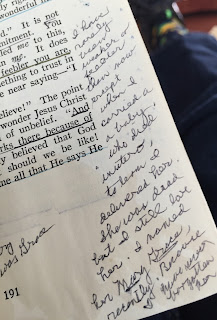 I shuddered and was moved to tears then when I read a recent comment she penned on July 9, seven months after her stroke, where Chambers asks "Have you the slightest reliance on any thing other than God?... You say 'But God can never have called me to this, it can't mean me.' It does mean you, and the weaker and feebler you are, the better." Her comment: "I have never been weaker or feebler than now, except when I carried a baby who I learned had died in utero when I delivered her. She was dead, but I still love her. I named her Mary Grace recently, because I have never forgotten her."
October 22. My birthday. Since I met Lisa, she has always sent me cards and various gifts – and she and Tom always phone me, singing “Happy Birthday,” and apologize for the quality of the music – and this is entirely chalked up to the inexplicably lousy quality of his singing, not hers, which is lovely. Then in the book I found her greatest birthday gift.
 A prayer, for me, prayed - how many times? "Today, Lord, my prayer is for James. It is his birthday. Give him a special gift today of your Holy Spirit at work in his life. Explode within him or quietly slip into the crevices of his mind and spirit that a seed of faith, your love and guidance may invade him in some powerful way."
Her observations, which could themselves fill a book (as they actually do now), are pretty much as wise as Chambers’s own. There’s this: “Intercession means that we rouse ourselves up to get the mind of Christ about the one for whom we pray. God does not call me to ‘understand’ the people for whom I pray, but to love them with His love.”
October 22. My birthday. Since I met Lisa, she has always sent me cards and various gifts – and she and Tom always phone me, singing “Happy Birthday,” and apologize for the quality of the music – and this is entirely chalked up to the inexplicably lousy quality of his singing, not hers, which is lovely. Then in the book I found her greatest birthday gift.

Her observations, which could themselves fill a book (as they actually do now), are pretty much as wise as Chambers’s own. There’s this: “Intercession means that we rouse ourselves up to get the mind of Christ about the one for whom we pray. God does not call me to ‘understand’ the people for whom I pray, but to love them with His love.”
And this: “I can only hear the voice of God when I
accept what comes with reverence. If I
accept it with resentment, then the rebellious cry of my own heart makes me
deaf to the voice of God.” Probably
years later, jammed into the small space left, she added “Forgive my
resentment, Lord. I want to hear your
voice.” I love that. The spiritual life most assuredly is not (a)
read a page of a devotional, (b) think it’s so good you absorb it with finality
and then (c) move on to the next spiritual challenge. It’s circular, with progress, setbacks,
insights and then you’re back where you started. God does not ask for perfection, or even
progress in our devotional life. Just
some spiritual tenacity. God wants what
Jean scribbled on more than a dozen pages in the book: “I want to give my utmost for His highest."


*******************************

Monday, February 20, 2017
Pastor's Book Club - February and March
I
thought it might be fun and instructive this year to host a “Pastor’s Book
Club,” not a small group meeting monthly, but a way for the congregation and
others to be reading a book together – and then to have the author or an
interesting person share with us about the importance of the book.
We began in January with Harper Lee's To Kill a Mockingbird - and Matt Rawle came and engaged in terrific conversation about it, which I'd commend to you! It's on YouTube.




We began in January with Harper Lee's To Kill a Mockingbird - and Matt Rawle came and engaged in terrific conversation about it, which I'd commend to you! It's on YouTube.

My
goal isn’t to “endorse” a book or its viewpoint, and the goal isn’t to say “reading
this will get you straightaway closer to Jesus.” It’s trying to read things that will stretch
us, or to read books others in our culture are reading and ask about the
implications for us in the church.
For
the “Pastor’s Book Club” this month, I wanted to read something related to
race, reconciliation – and also taking note of Black History Month. There have been so many books thoughtful,
provocative books out in just the past several months, which I’ve read and
tried to absorb – and I might have chosen any of them: Michelle Alexander, The
New Jim Crow; Ta-Nehisi Coates, Between
the World and Me; Jim Wallis, America’s
Original Sin; Bryan Stevenson, Just
Mercy; Michael Eric Dyson, Tears
We Cannot Stop; Debby Irving, Waking
Up White; even Jodi Picoult’s novel, Small
Great Things – and so many more.

We’ve
also had quite a few films that are eye-opening, and that achieve that old “afflict
the comfortable” – like like 13th (a
must-see documentary), the rekindling of The Birth of a Nation
as the story of Nat Turner’s rebellion, and the inspiring Hidden Figures.

Finally
I settled on James Baldwin’s short and thoughtful The
Fire Next Time, the 1963 classic of the Civil Rights movement, which
expresses, among many other things, remarkable compassion on white people. So interesting… I read it years ago, and have quoted it many times. I look forward to rereading it now, along with those of you who are interested and able.
My choice of this book coincided with the
release of a provocative film, I Am Not Your Negro – based on
Baldwin’s reflections on the assassinations of three of his close friends,
Martin Luther King, Medgar Evers, and Malcolm X. It's playing at two locations in Charlotte right now.

We
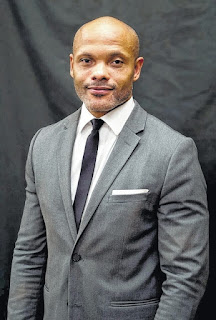
have Toussaint Romain, a local attorney, community advocate, and spellbinding
speaker, coming on Wednesday, March 8, 7pm, to talk with us about Baldwin’s book and whatever else he’d
like to share with us about race, religion and our city.
Next
month! (we’re a couple of weeks out of sync, sorry about that…), as we are
inviting our church family into a season of thinking about and growing in
prayer, I thought we might read a devotional classic together - one you might continue to read through the balance of the year. There are so many terrific books... I could list dozens and dozens.

So to pick a great one: we will read the devotional classic by Oswald Chambers: MyUtmost for His Highest. You could
actually get the book today and begin the daily readings!
I got more interested in this one when the Wall
Street Journal and then later that same week the New
York Times had reviews of a new book by Macy Halford’s My
Utmost: A Devotional Memoir.

She
tells how she was given her grandmother’s copy of this great book, but ignored
it for a long time. Finally she picked
it back up, began reading and learning also about Chambers himself. It’s a thoughtful book about a thoughtful
book. I like that.
I’m
working it out to have a grandmother and her granddaughter, both of whom I know
well, coming to share their very intergenerational perspective on this
wonderful daily devotional guide: what
it means to read a book over and over, year after year, and then to bequeath
such a book to the next generation.
Details shortly…
Thanks
for reading with me!
Sunday, November 27, 2016
A Divided United Methodist Church: How We'll Fail at the Main Thing
I’ve blogged quite a few times about our
fragile United Methodist Church, making the case for, but really just pleading
for unity. I’ve reflected on how our
Book of Discipline functions, on why Robert’s Rules of Order create dysfunction
in the Body of Christ, on how we relate to fellow members in that Body who
think differently.

I
have tried to point out that sexuality, while enormously important, and at the
core of what it means to be holy, is not at the center of our theology. Our cardinal beliefs, which pertain to
salvation, are about God, not us – and our sexuality is always a bit broken,
fallen, bedeviled by subterranean forces we hardly understand. I would exit the denomination if it declared
Jesus was just a man, or we are saved by works.
But not over a single practice among hundreds.
Most importantly, I’ve explained how
splitting up would be the worst conceivable witness to the unchurched, and to
our cynical world. If we can’t do any
better than the division and rancor in our country right now, we prove we have
nothing to offer.
Now, during this hazy time when the
Bishops’ Commission has been named, and when all we can do is pray for them,
and for ourselves – and as many of us feel gloomier than ever, fearing or even
expecting a split, I keep drifting in my mind to utterly practical questions. Like, if there is the dreaded split right
down the middle: What will I be doing for a living and where? Where will my pastor friends wind up? What signage will need changing? What won’t get paid for any longer? And in a way, the most pressing question of
all: What will become of the church
where I am serving?
Suppose we get the divorce. One denomination becomes two, a conservative,
brooking no deviation from straight or celibate sexuality, and a progressive,
allowing and even affirming same gender marriage and LGBTQ ordinations. What then?
The General Conference sends a memo to me and our board chair, giving us
ninety days or six months to select which way we go?

Our case is pretty interesting, indicative
of why there will be more carnage than we anticipate, utterly harrowing and
heartbreaking to me and the people I love.
Just the property: our trustees hold, in trust for the conference,
massive neo-gothic structures sitting on prime real estate in Charlotte. Both of the new judicatories would covet the
property, and the apportionment income.
Our contributions are a significant percentage of our conference’s
income now. But that amount will shrink
drastically for whoever winds up with our facility.
Because internally we would be forced to
make a choice we do not wish or need to make.
We have engaged in the arduous labor our denomination as a whole has
never engaged in: a prayerful, thoughtful, respectful conversation on the
theology and practice of sexuality. With
broad and strongly felt disagreement on the matter, we have chosen to stay
together, to love, and by our very unity to be a witness to the world.
And yet we would be compelled to make a
choice. How would that happen? Is it simply an item on the agenda of the
next Administrative Board meeting, and majority wins? Do we take a congregational vote, with each
member getting to cast a ballot? Would
there be campaigning within? Or even from outside groups lobbying to win Myers
Park?
I’ve tried to guesstimate what the tally
here would be. We have 5,200
members. We treat the children like
members, and also the super active adults, especially young adults, who’ve
never actually joined. But let’s leave
them out for now. Of the 5,200 official
members, I’d guess 1,600 wouldn’t pay attention or open their mail. Of the 3,600 left, I’d imagine 1,400 would rally
to the progressive side, and about 1,000 would go conservative. Or maybe it would be roughly a tie. Or maybe 1,400 to 1,000 the other way. What would happen to the "losers"? Of course, the remaining 1,200 would be too disgusted to
vote at all. Our young adults would, quite simply, be done with us.
Many – several dozen, I'd estimate – would exit
and become Southern Baptist, or Episcopalians.
I’d suspect that many more, though, in the hundreds, would just give up on church
altogether, if the one they loved and trusted couldn’t do any better than this
sorry state of affairs. And I would not
blame one of them. We’d suddenly have
more Sunday School classes, since they’d have to split too. Families would be divided over which way to
go. A 5,200 member church gutted, with
maybe 1,500 left.
We would quickly have to lay off two
thirds of our staff, and hack our mission spending down to a small fraction of
what it’s been. Within months, a clinic
in Haiti would shut down, families moving out of homelessness would head back
to the streets. We’d be the
laughingstock of Charlotte. The new
conference of the new denomination wouldn’t even be all that glad to have us,
as we’d have so little money left to send in.
Then where would the clergy we’d have to
let go wind up? Not only would the
financial decimation reduce the number of pastoral jobs out there. We would also have a rash of mismatched
clergy and congregations. If
congregations get to choose which denomination to go with, I’d imagine the
clergy would get to pick too. At least
in my part of the world, and I suspect all across the United States, on average
the clergy are far more progressive than their congregations. In Western North Carolina, for instance, out
of 1,000 clergy I’d estimate at least 500 would choose the new progressive
institution; but no more than a few dozen churches would do the same. Where would the clergy work? And who would pastor the conservative
churches?
I’m not a pessimist by nature. But I do sense there is considerable naivete
about how neatly a split might proceed.
I know those who think that basically the Southeast and the Midwest would
overwhelmingly go conservative, and the West and Northeast would go liberal, or
there might be a semblance of an urban/rural split, like the one we see now in
presidential elections.
But
it’s way more complicated state by state, and even church by church. The unforeseen ripple effects of a forced
division, even in a single parish like mine, would be catastrophic. A split in United Methodism, beyond the
heartache, the lost relationships, and the embarrassment of theological
surrender, would create a black hole of practical disaster. We would be the butt of church humor for the
next generation. And whatever shared
mission work we cherish would evaporate.
Purists will say you should do the right
thing, no matter what the consequences are.
But within our denomination, aren’t we picking one right thing, which
isn’t really the main thing, and then by picking that one right thing to be
right about, we render ourselves incapable of doing all the other right things
that really are the main thing?
Wednesday, November 9, 2016
The Morning After - 'Tis the Season #30
(This
is a blog I wrote several weeks ago, having no idea how it would turn out)


The election is over. For the Oval Office, one winner, one loser. But neither
is a loser. Both are people who offered themselves for public service, and have
lived under a microscope, under intense scrutiny, with a schedule that would
exhaust the most energetic of us.
Winning voters are tempted to strut, to gloat; losing voters are tempted to
sigh, to rage, to shudder with disgust. This is fine, and serves as an index
into the fact that we care, we are invested as citizens, we hold deep beliefs.
But the election is over, and we have a new President, and a coterie of
other public servants. Do we remain stuck in our giddy delight? Or in our
exasperated disappointment? Not as the people of God, not for those who believe
we might in some way be "one nation under God."

George Bush left a handwritten note in the Oval Office for Bill Clinton in
January, 1993, saying "I wish you great happiness here... Don't let the
critics discourage you or push you off course. You will be our President. Your
success now is our country's success. I am rooting hard for you."
What if God left a letter for us today? God would remind us it is time to be
one nation, one people, to throw all our support and hopes behind the
democratically elected officials who will lead. The alternative is forever to
oppose, to subvert, to grouse... but is the Spirit in us when we do?
You'll recall that my grandparents, back in
 January 1961, took down the photo
of President Dwight Eisenhower in their den and replaced it with one of the new
President, John Kennedy. They prayed for their President. Imagine if all the
people in America who claim to believe in God actually prayed for their
leaders? Or spent one-tenth as much time in seeking the heart of God as they do
in griping?
January 1961, took down the photo
of President Dwight Eisenhower in their den and replaced it with one of the new
President, John Kennedy. They prayed for their President. Imagine if all the
people in America who claim to believe in God actually prayed for their
leaders? Or spent one-tenth as much time in seeking the heart of God as they do
in griping?
If you believe that the election of Candidate X will be catastrophic, if you
think Candidate Y's policies are faulty, then you would be wise to begin to
pray, today, that you turn out to be wrong. The morning after an election - and
every morning for the believer, prayer is in order.
And citizenship. We harbor this foolish belief that just one person can change
everything. Leadership really matters. But leadership requires active
following, not passive spectatorship or hostile criticism. If there has been
energy and passion around this year's election, it will have been wasted unless
we translate that into consistent citizenship, involvement, each person doing
his or her part to work at the problems and hopes before us, every organization
- and especially the Church getting engaged with what's going on with
compassion, justice, an optimistic spirit, and a dogged zeal.

So let us conclude by recalling the immortal words of Lincoln, trying to lead a
divided nation, and make them our hope, our prayer, our marching orders:
"The prayers of both could not be answered. That of neither has been
answered fully. The Almighty has His own purposes... With malice toward none,
with charity for all, with firmness in the right as God gives us to see the
right, let us strive on to finish the work we are in, to bind up the nation's
wounds."
Tuesday, November 1, 2016
Not Voting? 'Tis the Season #27
More than in any election
in my lifetime, I’ve heard so many people say “I just can’t vote for Trump or
Clinton.” Mind you, in 2012, 42% of
Americans didn’t vote for Obama or Romney! and this figure is always worse in
local elections. Do Christians have an
obligation to vote?
What we have right now is not that people
are too busy or too uncaring to vote.
They are voters; they care deeply – but cannot in good faith pull the
lever for someone they loathe. The
philosopher Alasdair MacIntyre argued for this kind of ethic: when we are given
two bad options, we must choose neither.
This I understand and feel. But something about it feels odd, even
troubling to me – and for three reasons. (1) None of us has ever, ever voted
for an un-flawed human being. Christians
should know well that all of us are broken, fallen, sinful, confused people,
with hidden turmoil and a string of botched decisions in our past. Is there some threshold of “good enough”? and
if so, where would you draw it? and if you did, is that line where you happen
to be, or are you above or below it? If
I pass judgment on candidates (and in a way, we all must), is there
simultaneously a huge log in my own eye?
(2) Maybe of more interest is this: if I
just can’t cast my vote for either person, am I treating my vote as something
sacred, or utterly holy? It is lovely and
fitting to think of your vote as a huge deal, not to be squandered
lightly. But is it so sacred, does it
have a pristine history of purity, that it can’t be soiled? Or is my vote my best stab at doing my small
part in helping the world to be less woeful than it would be if I withdrew?
(3) Almost every day, I find myself faced
with some choice between bad options, and you do too – so we should be used to
it. Some are little trifles, some are
heart-wrenching, but the decisions we make in our working and personal lives,
if we step back and ponder them from the perspective Jesus might have, in a
fallen and constantly compromised world and culture, are really in that “lesser
of two evils” zone. And you find each
day that not to choose really is to
choose, because something ugly steps into the vacuum where you were supposed to
be. Not choosing is itself a choice that
does impact the outcome.
But I am not at all sure about these
things. They are just questions that
surface in my gut when I think about just not voting at all. Even if you can’t go for Hillary or Donald,
there are other important elections at the state and local levels…
Subscribe to:
Posts (Atom)
.jpg)